
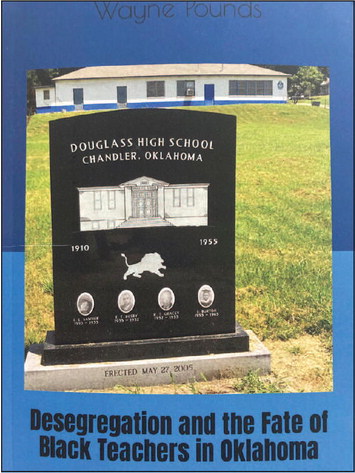
Wayne Pounds’ book, Desegregation and the Fate of Black Teachers in Oklahoma examines the effects that supreme court rulings and changing state laws had among the African American teachers and administration in the state of Oklahoma between 1955 and 1970.
As a former resident of Lincoln County, Pounds relays the accounts of 15 teachers who taught at Chandler’s Douglass School along with others at other various black schools around the state. With his focus more on this localized group, Pounds is able to give light to the struggle that black teachers faced in Oklahoma by capturing their individual stories rather than a broad scope of the situation that is already covered in several books with more of a wide spread topic.
“This series of essays began as a study of the fate of teachers in Chandler’s black Douglass School,” Pounds said. “The frame, however, seemed too small, so it was enlarged to provide a limited overview of other towns and their schools. It was never intended, however, to be encyclopedic in scope and thus does not try to be comprehensive.
“The book’s starting point is a 1951 speech discussing the implications of recent Supreme Court rulings given by the great African-American spokesman and leader W. E. B. DuBois. He posed the hidden question that black educators across the country were asking themselves: “what becomes of all the Negro teachers?”
“‘That was a question no one else was asking in 1951, but within another decade it became the overwhelming question for black educators in Oklahoma, and in recent years the state’s lack of black teachers has forced it back into the spotlight.
“As a local historian, however, I started with Chandler’s own Lena Sawner, the first woman principal in Oklahoma and the first African-American principal in the state. A parallel beginning was provided by the figure of Irene Virginia Moon, the obscure sister of the state’s premier black educator Frederick Douglass Moon, who made his reputation in Oklahoma City. The Moon family were poor Lincoln County farmers who homesteaded near Fallis, and some of them are buried in the Belton (a.k.a.) Great Hope Cemetery.
“A final limit is posed by the Civil Rights movement which has its historic origins in the Brown v. Topeka School Board Supreme Court cases of 1954 and 1955. Since it took over a decade to dismantle the old Jim Crow system, major civil rights cases like the Baptist Church bombing in Birmingham Alabama on September 15, 1963 appear at the margins of my canvas, as, for example, in the essay on Cushing when students are mentioned demonstrating against the bombing.”
Copies of this book are available in a limited amount at the Lincoln County Museum of History in Chandler.