
On an unusually cool and cloudy summer morning, my car kicked up dust as small frogs darted from the gravel road leading to Kendrick.
After reading the small amount of history I could find online about the town, I did not really know what to expect. As I arrived, the gravel gave way to pavement, and I was welcomed by manicured lawns, well-maintained homes and a few children riding four-wheelers and scooters.
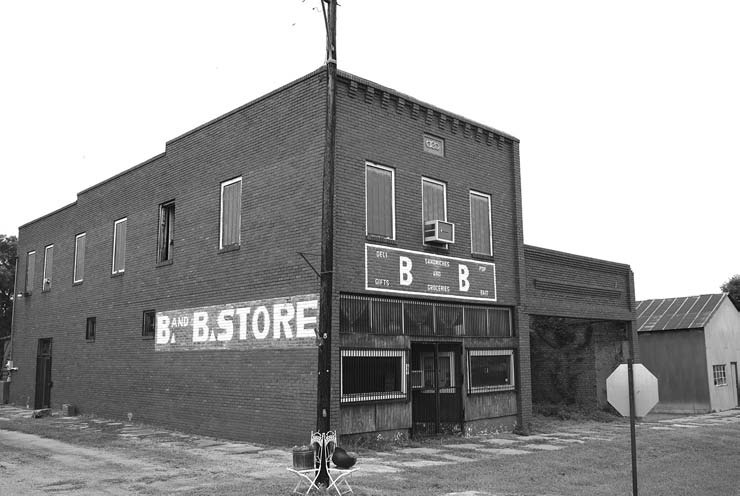
Near the town hall at Main and Third streets stood the deteriorating remains of the B&B, Kendrick’s last retail business and, for decades, one of the town’s central gathering places.
The town hall itself was small but tidy. The lights were on and the door was open, so I walked inside. I was greeted by Patricia Webb, a Kendrick resident who works there and helps care for both the building and the history stored inside it.
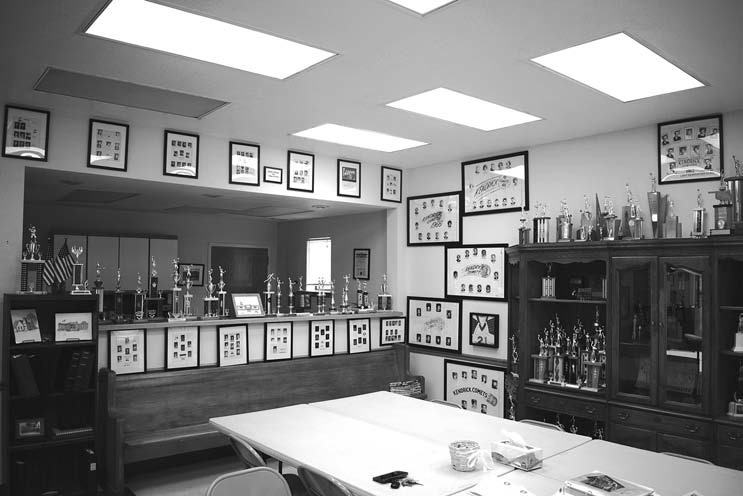
The walls were lined with dozens of school trophies, framed class portraits and photographs of Kendrick’s original buildings and defining moments, some dating to the late 1800s. Webb pulled out handwritten histories, copies of old diaries and photographs of train wrecks, businesses and residents who helped build the town.
Much of the collection had once been displayed inside the B&B. Residents and former residents sent photographs and written memories to the B&B’s former owner, the late Dorothy Stewart, and school trophies, class pictures and other materials were gathered there after the school closed. The materials tell the story of a community that appears quiet today but once had passenger trains, cotton gins, filling stations, newspapers and a busy Main Street.
What would eventually become Kendrick began taking shape in 1902 as the Atchison, Topeka and Santa Fe Railway built a line through the area. A post office opened under the name Avondale that October, and the town plat was filed Nov. 12. Lots went on sale two days later, according to the Oklahoma Historical Society (OHS).
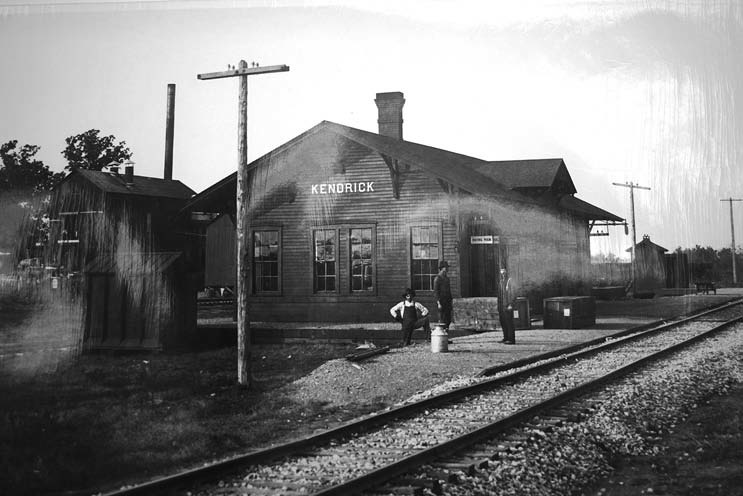
Railroadofficialsnamed the train depot Kendrick in honor of Santa Fe Vice President J.W. Kendrick. The post office adopted the name in January 1903, and regular passenger and freight service began later that year, OHS said.
The railroad bypassed the nearby community of Parkland, and business owners there were offered free lots to move closer to the new line. The Bishop family mercantile building was jacked up and physically moved to Kendrick, while a cotton gin was relocated from Parkland in 1903. Other businesses included four general stores, two drugstores, a lumberyard, a livery stable, a hotel, a restaurant, blacksmith shops, a barbershop, a pool hall, a photo gallery and a saloon.
The railway brought enterprise to Kendrick, but it also brought people seeking to take advantage of the up-and-coming town. Kendrick was a known hot spot for early Oklahoma outlaws such as the Doolin-Dalton gang and Henry Starr. A cave where some of the outlaws reportedly hid is just outside Kendrick, said Webb.
The bank was first hit in 1903. Chris Davis, who lived in his business east of the bank, was shot in the leg during the altercation but survived, and the suspects were not convicted, according to historical documents at the town hall.
The most dramatic attempt came in 1916, when robbers used dynamite to blow up the wooden bank to reach the safe. The blast woke townspeople, who promptly opened fire and drove them out before any money was taken from the safe.
After the 1916 dynamiting, a brick building was built to house the bank, but it did little to deter further robbery attempts. Someone tried to dig into the vault in 1924, and in the following year, robbers hauled the safe away on a truck before it was recovered from a pond in Creek County. In 1929, the bank was robbed once again, and Errett Blakley was shot in the leg. The Wild West was very much alive in 1920s Kendrick.
By the time Richard Bailey was growing up outside Kendrick, the robberies had faded into history and the town had grown smaller and quieter, though it still had a school, a grocery store, a garage and an active community.
“Of course, we were country people, so that was a town to us,” Bailey said. “Even though it was just a grocery store and school, we had a little garage there just to the south of the grocery store where we could get gas, and they did a little work on cars and buses and stuff there.”
Bailey attended school inKendrickthrougheighth grade before continuing in Davenport.
“Coming to school was really our activity to get away from the farm,” he said.
Some of Bailey’s best school memories are of the box-lunch auctions.
“The school would have things where everybody would come in and they would bring box lunches, and then all the women’s lunches would go up for auction. You would buy them, and then you would get to sit and eat in the gymnasium with the women that you bought their lunches. And, of course, I always bought a high school girl’s lunch,” Bailey said, chuckling.
Once a year, residents gathered for what Bailey remembers as Old Settlers Day.
“Everybody would get togetherandwe’dhavebig lunches laid out,” he said. “I remember that the older people, which was my dad and them, would all go out and play baseball.”
The gathering began fading during Bailey’s high school years as the town’s older residents aged. Kendrick’s final high school class graduated in 1962, although the elementary school remained open into the 1980s.
“When the elementary school finally closed, things just started kind of fading away,” Bailey said.
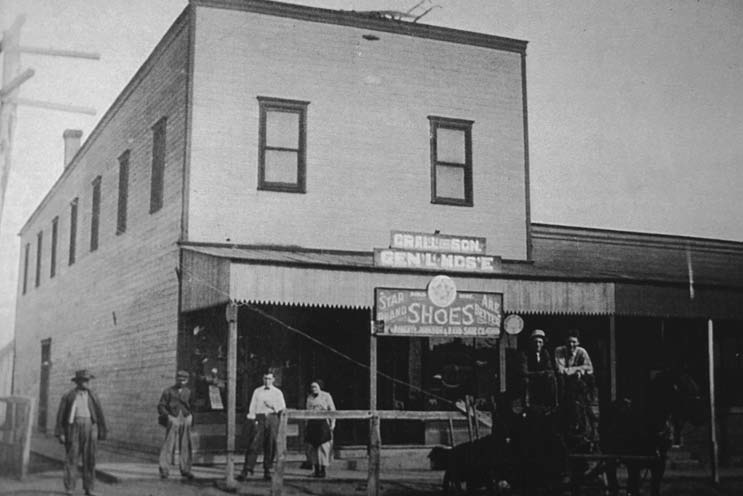
Yet the B&B continued. Originally, the Crall and Sons Mercantile operated fromawoodenbuildingon the site during Kendrick’s early years. The building also served as a lodge for the Independent Order of Odd Fellows until it burned down. It was replaced in 1905 by the brick building that eventually became the B&B.
Errett Blakley, the same man shot in the leg during the 1929 robbery attempt, purchasedthestorein1935 andnamedittheB&Bwith the hope of running it with his son, Leo. After a summer of working with his pops, Leo scooted off to Stillwater, where he later became a professor and dean at Oklahoma State University.
Blakley stayed and ran the B&B until 1975. He reportedly opened the store at 6 a.m. and remained open until 10 p.m., closing only an hour earlier during the winter.
“You could get everything frompharmaceutical stuff in there to groceries,” Bailey said. “You could get clothes, car parts and just a little bit of everything there.” The store also carried seed, coal oil, lumber and feed. Customers could order a sandwich or stop in for ice cream or a bottle of pop. Blakley reportedly bragged it was the last shop in Oklahoma to sell dynamite over the counter.
If he did not have something, he would order it. Blakley traveled to Tulsa or Oklahoma City about once a week to bring back supplies.
“If you needed something and he didn’t have it, well, he’d pick it up while he was up there,” Bailey said.
BaileyknewtheBlakley family personally. His first job was working for Errett’s brother, who lived across the road from Bailey’s family. “He’d come get me to help him work cattle or fix fences and everything, and pay me a quarter an hour,” Bailey said.
Later, Bailey helped Errett with trips for the store.
“I’d even made some trips to Oklahoma City to pick up feed for him and stuff,” he said.
Residents also paid utility bills there, stopped in to hear the latest news and used it as a contact point with firefighters before modern radios and phones became common.
“There would always be some of the older townspeople sitting on the benches talking and drinking a Coke,” Bailey said.
After Errett’s passing, his brother Merle ran the store until it was purchased by Dorothy Stewart in 1979. Despite moving all the way from California to Kendrick with little business experience, she ended up making a large impact on the small community.
She expanded the grocery selection and ran the store until renovations required it to close for several years. She reopened it in 1994 with heating, air conditioning and other major improvements.
Stewart made sure to continue its legacy as the town’s community center, with residents coming to the shop every day for groceries, sandwiches and conversation.Alumni gathered there for a yearly parade, the first of which reportedly drew 350 people. Nearly a century after the building opened, Kendrick residents were still gathering there, now sharing the store with Route 66 travelers and oil and construction workers stopping for lunch.
“That was the business of the town,” Bailey said. “Any revenue was generated through the sales tax and stuff like that.”
Stewart did not stop at improving the B&B. She helped the town obtain a $635,000 grant to replace deteriorating septic tanks with a municipal sewer systemandawater-system grant worth more than $1 million. Bailey said he believes she also played a role in establishing the current town hall.
Webb said Stewart remained connected to the business until her death around a decade ago. It has since closed and changed ownership multiple times. The most recent owners purchased it for use as a marijuana-growing operation. During a winter freeze, flooding caused major damage, and the former B&B is now in significant disrepair, awaiting its fate.
Bailey still drives through Kendrick regularly on the way to the farm his great-grandfather homesteaded. He would like to see the B&B restored and possibly reopened as a small store, althoughheacknowledges it would not be a business that would “set the world on fire.”
“It would be wonderful if they could at least restore the building,” Bailey said.
While the B&B may be gone for now, the Kendrick Volunteer Fire Department reflects the community’s continued willingness to build and maintain what the town needs.
Bailey helped establish the department in 1976 after residents began piecing together equipment from donations.Theyconverted a donated truck and a 2.5ton military cargo truck for use by the department, received an aging 1947 Mack pumper from the Oklahoma City Fire Department and repurposed discarded bunker gear.
“We just begged and borrowed,” Bailey said.
The fire station later hosted Kendrick alumni banquets and remains one of the places where the community gathers, although the surviving alumni now number only about 30 and generally meet at a restaurant in Davenport.
Much of the history Stewart, Bailey and others worked to preserve is now cared for at town hall.Visitors who stop by and sign the guest book can view scrapbooks filled with photographs of Kendrick from the late 19th and early 20th centuries, along with newspaper clippings and diaries containing handwritten accounts of everything from the robberies I mentioned to the train derailments I did not.
Today, Kendrick no longer has its school, post office or store, but its fire department remains active, its history lines the walls of town hall and children still ride fourwheelers past the remains of the B&B.
“We all love the little town,” Bailey said, “and would like to see it continue.”
Editor’s Note: This is the first in a series of articles on Lincoln County’s forgotten towns.