Murals throughout Lincoln County
With concerns over COVID-19 still looming, travel this summer may prove difficult. But that doesn’t mean that individuals can’t explore the attractions in their own backyard, that they may never have visited before.
Route 66, known alternately as the “Mother Road” and “America’s Highway,” was formed in the 1920s as the first highway connecting Chicago and Los Angeles. Cutting straight across Lincoln County, the highway shaped a significant part of the region’s history, and its attractions offer an important glimpse into the past, as well as a welcome chance for fun without traveling far from home.
Giant words scrawled across the side of a barn, ghostly promises of the refreshing power of Coca-Cola, horse drawn wagons bursting forward from the bricks of an old Mason Lodge building… a history lesson can be read from the walls of Lincoln County.
Many of the signs and murals along the old Route 66 – from Wellston and Chandler to the main street of Stroud – tell the story of the past. Although some of the murals are not on the modern Hwy 66, many of them were on Route 66 back during earlier stages of the Hwy.
Traveling across the county from East to West, one of the first sights is the old Coca-Cola sign on the Eastern side of Stroud Art’s building in downtown Stroud.
Once a ghost sign – a term for original historical signs that have faded over time but are still visible – the Coca-Cola ad was most likely painted back in the early days of the building, in the 1920s or 30s.
“Coca-Cola had a big marketing program where they would paint murals or have different artists across the country paint murals for them,” Stroud Arts board president David Timmons said.
The mural-style signs were common.
“And, of course, back in those days you know a lot of cars didn’t have air conditioning,” Timmons said. “It was really hot so you see that sign and ‘go yeah I’d sure like a nice, refreshing Coca Cola.’ And at the time the [Stroud Arts] building was, I think, a café.”
He said it was most likely built in the 1920s or ‘30s.
“It’s been a lot of things over the decades, from a barber shop to a donut shop, restaurant or café, and a video store and now is currently the home of Stroud Arts,” Timmons said.
Sometime around the 1980s, the Stroud Friends of the Library helped restore the sign.
Stroud Arts, who started renting the space from the Chamber of Commerce after officially becoming a 501(c)3 in 2014, launched a second restoration project.
“We’re a nonprofit arts organization that focuses on programs, whether it’s presentations or training, all forms of art for the people who live in and around the Stroud Area,” he said.
The organization received funding from Keep Oklahoma Beautiful and Stroud Regional Medical Center and hired Palmer Studios, Inc. to restore the sign in Mar. 2019.
“We debated whether we should restore it because there are a lot of people who hunt for ghost murals,” Timmons said.
The Stroud Arts board decided on the restoration because of the message they wanted to give about city.
“If you see something that’s, you know, fresh and restored and well maintained, then you get a different perception of the community,” Timmons said. “And, you know, that’s the […], first big thing people see when they come in on the east side of town.”
Bob Palmer, of Palmer Studios, Inc., said he aimed to remain true to the original design during the restoration.
The town features several other murals by various artists along the main downtown stretch of Route 66, including a flower mural on the Stroud National Bank and a historic mural based on a pen and ink drawing also along Route 66.
Continuing to travel Westward on 66 after leaving Stroud, drivers can spot another example of Palmer Studios’ work.
At the curve where Route 66 exits Davenport, a mural sign welcomes visitors, paying tribute to the area’s history by depicting the Route 66 symbol, a historic Magnolia Oil Company filling station and the original overpass over the Santa Fe Railroad.
Leaving the modern Hwy 66 to drive south from the 7th and Broadway intersection, six additional murals adorn the walls of Davenport’s downtown buildings. Covering the walls of business such as the old Masonic Lodge and the Davenport New Era newspaper office, the murals each depict a historical scene.
“They record the actual history of the town because they’re actual photographs of Davenport in the early days,” editor of the Davenport New Era Don Sporleder said. “So, those photographs show stains of the town just the way they were, the year those pictures were taken.”
The historical photos and images recreated include a Harper’s Weekly Magazine image of the 1889 Oklahoma land run, which Davenport celebrates as the tallest mural on Route 66, and a portrait of Nettie Davenport, who was the first post master of the town and its namesake.
“All history is important,” Timmons said. “And it’s important for towns to remember how they were established, how they changed through the years – and what the core history is of the community. So that, that helps people see exactly what it was like.”
In order to keep the photos as accurate as possible, Palmer and his assistants used a special night technique.
“Usually we lay in the background color like a sky blue, a general green for grass, just kind of guesstimating where things are going to go,” Palmer said. “And then we’ll project the image on top of that, sketch it out, and then we obviously had to do that at night. And then we painted out the next day.”
Palmer said that they often had several people watching as they painted.
“I’m so proud of Dr. Palmer and his artistic ability,” Timmons said, “because when you compare those murals to the actual photograph, they’re just right on the money. And they’re just, the artwork is just spectacular.”
An older example of Palmer’s Route 66 murals can be found in neighboring Chandler. Age has somewhat faded the details of the tawny dirt and blue Okla. skies depicted along the wall of Bud Blakley lumber yard, which Palmer said he painted several decades ago.
Pulling into the Chandler Donuts and Coffee parking next door, visitors can easily view another historic symbol of Route 66 across the street.
A series of slowly faded historic Coca-Cola signs as well as a sign for the St. Cloud Hotel can be seen on the top of a neighboring red brick building’s Southern wall.
The building was originally two buildings that now share the same front wall. The man who built the St. Cloud Hotel in 1903 bought the other building as well, and ran the facing of the hotel across its neighboring building also as he was finishing the hotel.
“The man was from Europe and the St. Cloud Hotel was named after his boys’ school,” the building’s owner John Givens said.
The European influence can be seen in the hotel’s architecture, he said, and the usage of the building evolved over time.
Givens bought the building around 1981-1982 and the historic exterior signs were restored in 2007.
“It was fading and so I thought it would be a write-off for advertising for them, so I called them, and got ahold of the advertising company or the guy that was over advertising and the Coca-Cola company redid the signs for me,” Givens said.
Part of the building is now rented by Russell’s School of Kirate.
Givens said he petitioned the city for and received permission to redo the building’s exterior balcony as well but was unable to launch the project.
Wandering farther Westward in Lincoln County, drivers might spot another ghost sign.
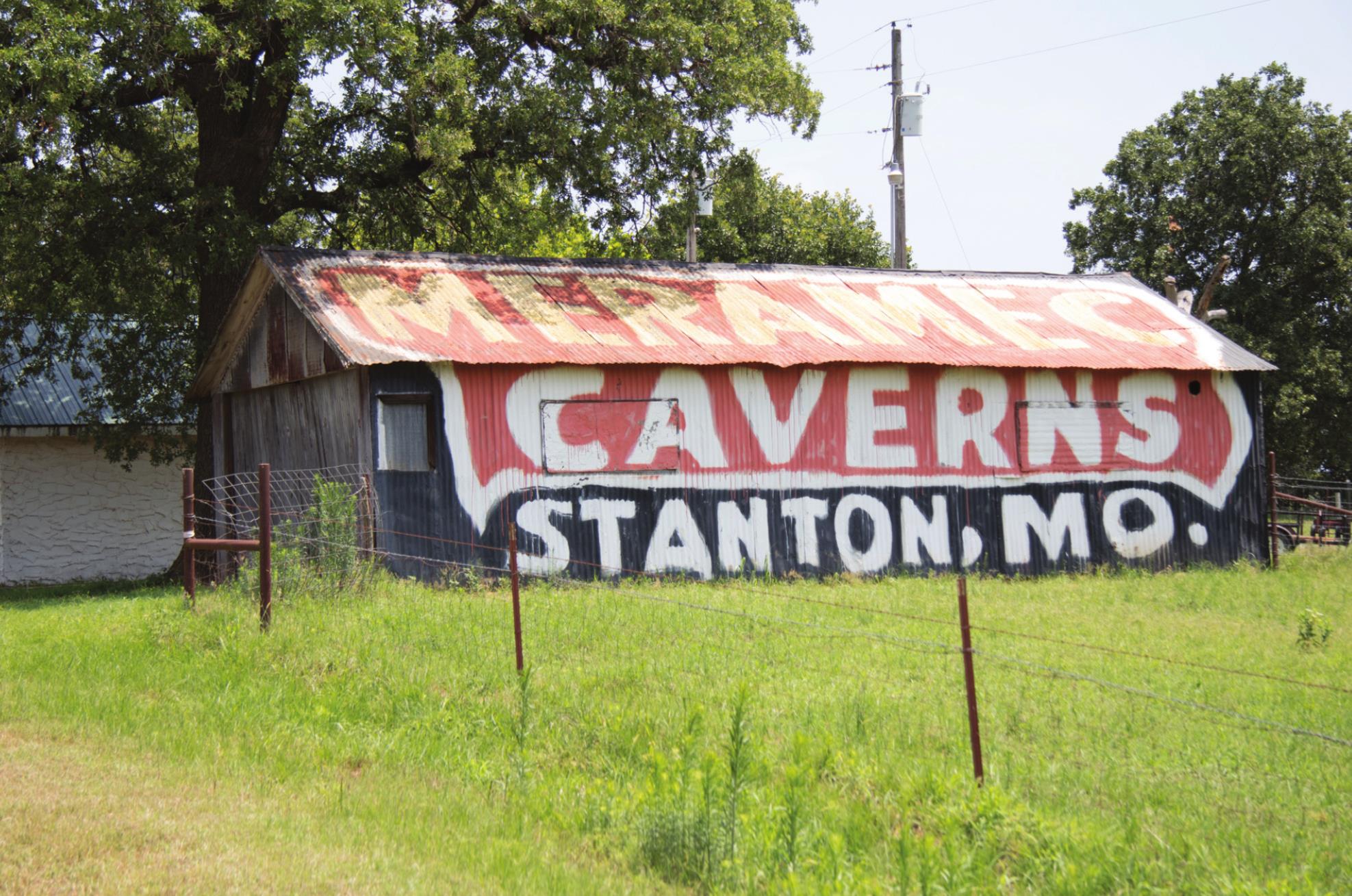
The weathered western side of an old barn features a giant bold sign for the Meramec Caverns.
Although located in Mo., Lester Benton Dill, the man who first began providing tours of the caverns, advertised all along Route 66.
According to the Meramec Caverns webpage, Dill had employees tie signs for the caverns to the bumpers of visitors’ cars in an early form of bumper sticker, and having advertisements painted on barns across 14 U.S. states.
The home studio of Bob Palmer, Red Dirt Art Gallery and Studio is located in Wellston, and the city is also home to another mural celebrating the town’s history near Cedar Ave.
The many murals and signs throughout Lincoln County provide a unique opportunity to residents.
Palmer said he wants to take the time to travel the “Mother Road” for himself.
“We get some visitors from international, that are out of the country,” Palmer said. “And I really like their attitude. They come all the way over here just to travel and, and we kind of take it for granted. You know it’s right here in our backyard and maybe we don’t think that much about it.”