
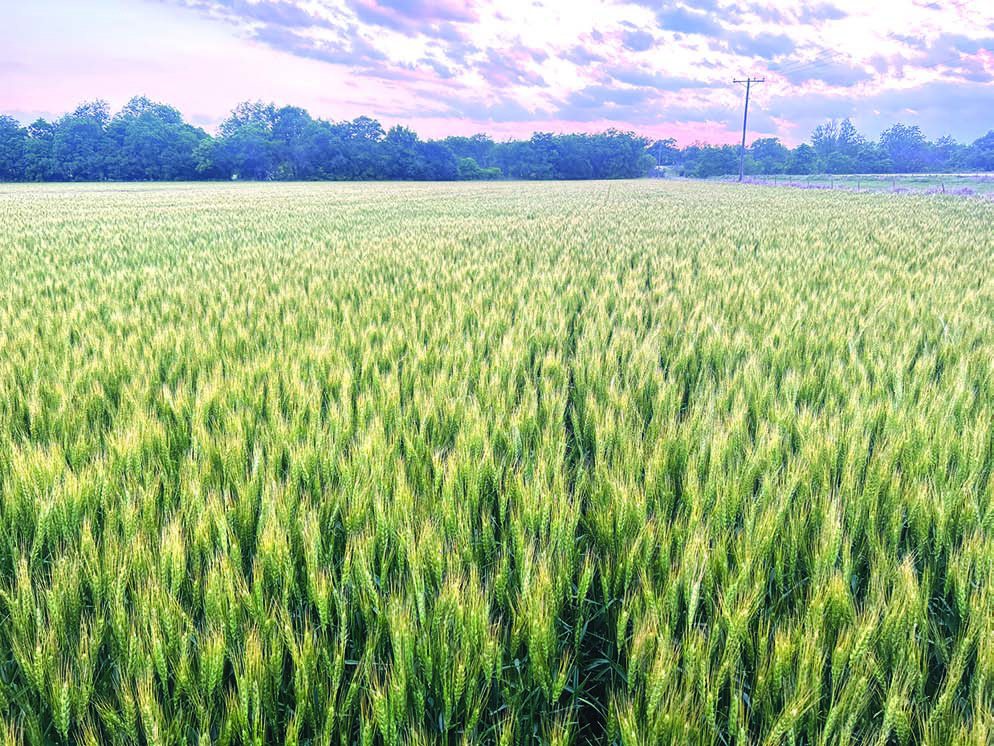
A local farmer in Carney is working to bring back wheat to the area.
Matt Dornan recently competed in the National Wheat Yield Contests, winning second place on the percentage over county yield, which was 10.45 bushels an acre, and first place in quality.
What’s more, he uses a field where his grandfather used to farm. Dornan said his grandparents purchased the land in 1954 and farmed it with his grandfather’s brother. It’s where he began learning to farm when he was younger, even though his grandfather always wanted him to do something else. Dornan said it’s hard living, but it’s a good one.
“I like doing it because there’s just not many jobs that you can get up in the morning and think you’re probably going to go lose some money today that you enjoy going and doing it,” he said.
Farming is a full-time job for Dornan. He has a small dairy that he runs along with farming about 800 acres of cropland just north of Carney. He said he tries to take pride in doing the best he can, attributing it to something his grandfather used to say: “You don’t need to be the biggest farm. You just need to try and be the best.”
Dornan said that wheat has kind of been a dying breed; however, technology has come a long way as far as fertilizers, soil samples and different genetics that succeed, which has been a real game changer. He incorporates newer technology to help with everything from being more efficient with fertilizer and fine-tuning which kinds of wheat work best in this area.
“I raised wheat in the past, but the quality and the encroachment of rye grass just got too bad. So we quit for a while and went to raising corn and soybeans,” he said. “And then we incorporated that wheat back into our rotation. And I recently come across an opportunity dealing with Shawnee Milling.”
Dornan raises wheat used in flour. When he entered the yield contest, a 10-pound same was sent to a lab in Kansas City to test the milling and baking qualities, which is where he one first place in quality.
“It’s kind of neat to be able to raise something here and send it right down the road to Shawnee, and they actually put it in an end-product to send to the consumer,” he said. “You know your products are staying somewhat local and that’s kind of neat.”
Like with other crops, it’s a give-and-take. Dornan said last year they had a bit of a beating. It was dry when they planted, which led to a dry winter. Then it started raining and didn’t quit. He had just a long enough window to cut and harvest before it started raining again.
While Lincoln County has traditionally been farmland, it can be difficult to get started. Dornan said he believes the cost of land and input costs are some of the biggest challenges here. It’s because in this area, it takes a bit more fertilizer to grow good crops versus somewhere like Illinois or Iowa, which have really deep topsoil.
His biggest advice to anyone looking to farm? “Adapt to changes in technology and be diversified,” he said.
It’s advice he takes himself. They use auto-steer on their equipment, so there’s no overlapping or skipping. They also have swath control on their sprayer to prevent over-spraying. Currently, he’s looking at pulling one-acre grid soil samples.
“It’s called variable rate seeding and fertilizing. So instead of pulling a soil sample on the whole, you know, say the whole field just needs, you just put 300 pounds of fertilizer down. That field may not need that because this one acre over here may only need 20 pounds. So that’s the best for your pocketbook and the environment, as far as no nitrification loss and no leaching,” he explained.