
The sound of engines filled the air as Ralph Snider’s jet dragster sent off billows of smoke and flame before launching itself down the track.
Now vice mayor of McLoud who builds cars in his spare time, Ralph Snider’s love for fast cars goes back to his childhood. He was 14 when he built his first car.
“My mom didn’t know about it,” he said. “Until when she found out, then she took it and sold it to discipline me. So, I just went and bought another one and kept it somewhere else.”
He had gained the skills to build his own car from Bruce Jacobson, owner of Glendale Machine and Balance.
“When I was a little kid I had a newspaper route, and I delivered to a place called Glendale Machine and Balance who built engines,” Snider said. Later on, he started learning from Jacobson.
“And then, after my newspaper route I go and sweep floors,” he said, “and then after that, he [Jacobson] started learning, teaching me how to do valve jobs and bore blocks and hone and all that good stuff. So, I was learning how to build my own.”
While growing up on the West Coast, Snider started street racing.
“Back on the West Coast, it was an every weekend deal, just meet up, different areas, pick who wanted to race who,” he said.
He eventually shifted away from street racing.
“After a bunch of tickets in one year, I decided in ‘78 I better start going to racetracks,” he said.
Around the same time, he started working in trucking—a career he continued until 2011—and it was his trucking career that brought him to Oklahoma.
“Believe it or not, Oklahoma, you could be north, south, east or west within a day, day and a half, somewhere,” Snider said. “So, in 1990, I moved my family out here.”
His passion for jet speed in the body of a dragster car began around 1981 and took him across the world.
“With the jet car we’ve been known to go all over, I don’t know what year it was—I think it was ’96 we took one to Japan, and then I took one to England,” he said.
Then he took time off to help get his daughters through college before returning to build another car, talked into it by his daughter.
Now, the city council member keeps a workshop outside his home where he builds and repairs vehicles for himself and others.
He has several current projects in various stages, including two jet funny car chassis, and a finished jet dragster that he takes to events.
“These got the nickname funny car, because of the way that they were all cut up, put together and stuff, for fuel cars,” Snider said.
One of the best parts of working with the cars is seeing people’s reactions, Snider said.
“I love going fast, and I love putting on shows, and I love it when the little kids come by because they got to learn,” he said. Snider built his dragster himself.
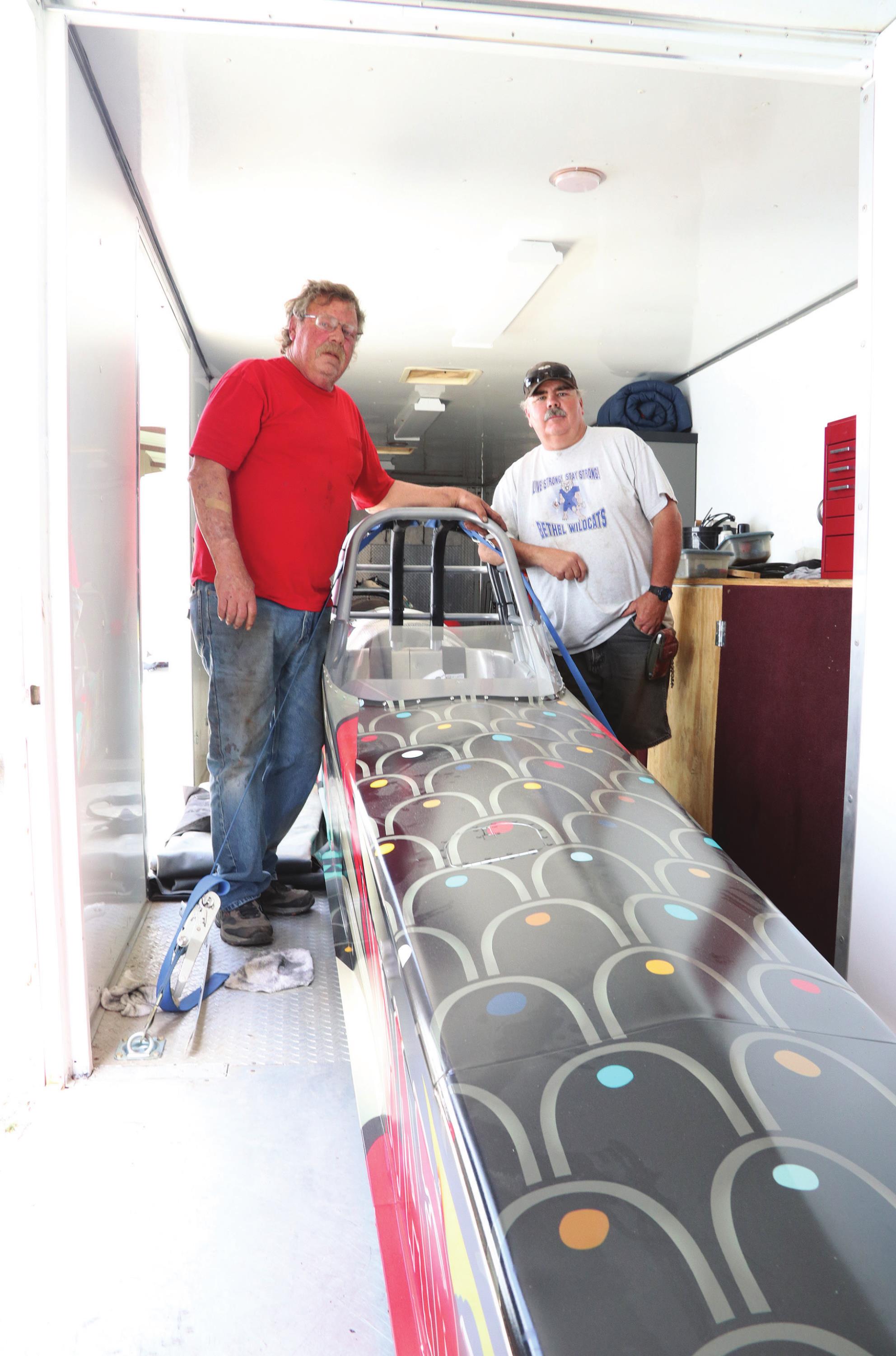
“It was fun building the car that’s in the trailer [pictured],” Snider said. “But it was a headache to get it to run. We had a couple bad engines, so we’ve finally got one that’ll make it run.”
He hopes to take another one of his car projects to Specialty Equipment Manufacturers Association’s (SEMA) event in Las Vegas this year. Before the event, the car will be finished and painted at Downtown Auto Body in Shawnee.
Typically, Snider aims to attend 20-22 events each year, but the challenges of the COVID-19 pandemic have drastically reduced the number of events over the last several months.
“I mean after this pandemic hit, it’s been so bad,” Snider said.
Last year, he attended two events and he’s planning on attending two this year.
The cars he works with are exhibition cars, so the events focus on the performance, rather than racing.
“We don’t run for money—you know, like a prize or a winnings—,” Snider said, ‘but we put on a show.”
He funds his cars himself. “Probably the hardest part in there would be finding the time and finance and everything to go run like you’d really want to run on it,” he said.
He plans to start training Marcus Parks to drive the jet dragster this summer and the two first met when he helped Parks build a truck around 20 years ago. Parks’ enthusiasm for jet dragsters is clear in how he speaks about them.
“It’s something unique,” Parks said. “I mean, a top fuel car, they’re all piston driven, but you take something that’s on an aircraft that makes an aircraft fly, you put it to a chassis and run it down a strip.”
Training to drive a jet car is all about practice.
“Going to the track and doing a bunch of laps,” Snider said. “First engine only, no afterburner, and the car will still run about 171 to 180 in the quarter, just engine only and won’t run, it won’t do like 270-280.”
The idea is to practice until it becomes instinctual.
“He’s got to feel the parachutes,” Snider said. “He’s got to learn how to start it without hurting it, and just get a feel for it to see if it’s something he wants to keep doing. Because if you, with these cars if you have to think about what you’ve got to do next, it’s over with. You’re in trouble.”