
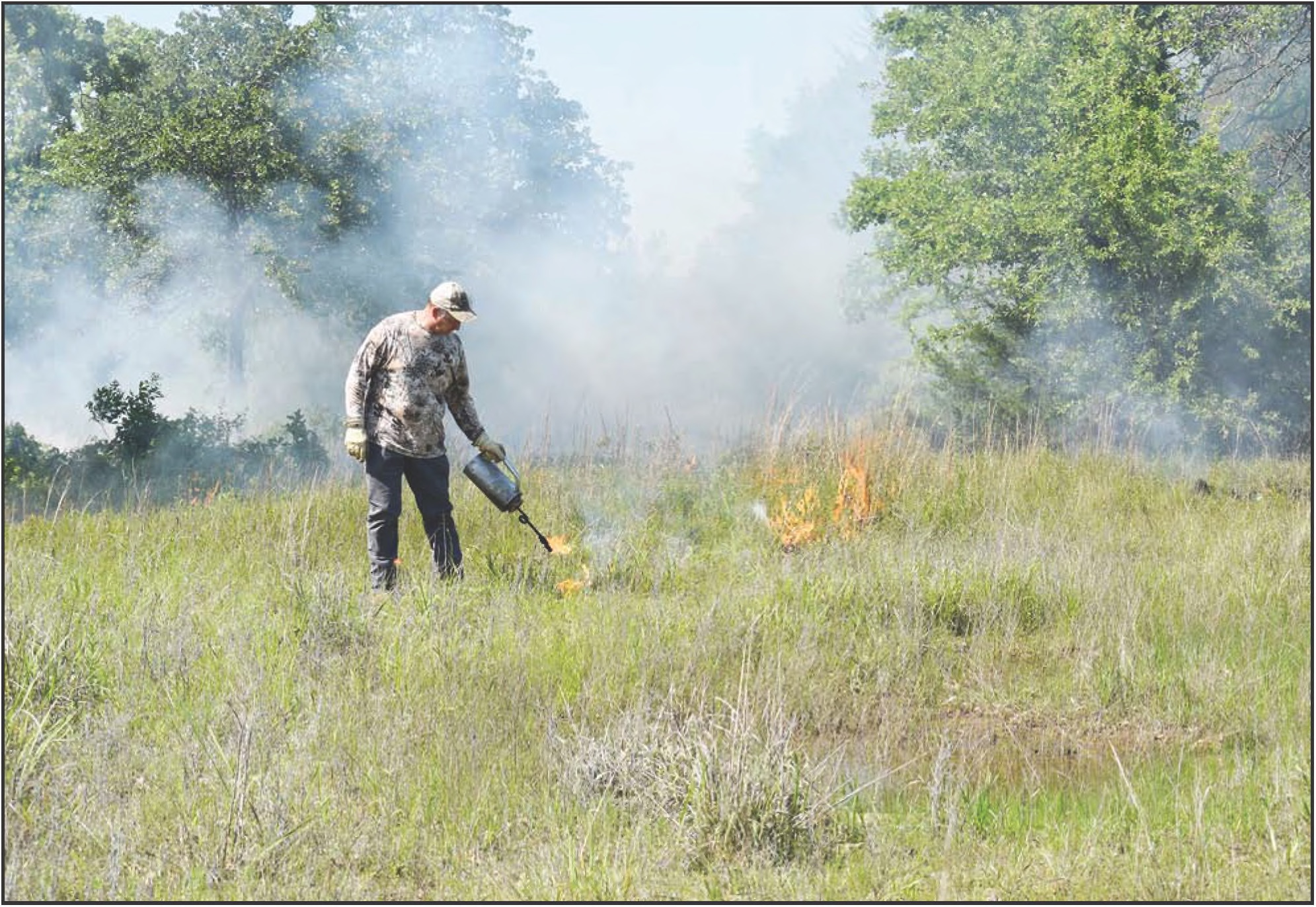
Flames slowly crawled across the land, gobbling up grass as smoke filled the area. As it hit a pile of dead cedars, they erupted, quickly growing until the entire tree was engulfed and the flames shot up several feet into the air.
In other circumstances, this could be a scary situation. However, for the small group of volunteers from Cross Timbers Prescribed Burn Association monitoring the fire, this is just another prescribed bum.
Mark Hildenbrand has been president of the association since around 2019, though he’s been involved since 2017. While he doesn’t own land in Lincoln County, Hildenbrand had experience with prescribed bums on his property in Payne County. He attended a field day with the Lincoln County Conservation District, where he heard about Cross Timbers, and said the neighbor-helpingneighbor aspect of the group attracted him.
“I tell people... it’s like back in the day when you’d have neighbors helping neighbors and that being like a bam raising,” he said. “We’re gonna go help build John Smith’s bam. So, they all got together and did it, and then it might be your bam that they build next.”
The group currently has about 125 members, who pay $25 a year. Prescribed burns, which the group prefers over controlled burns, are beneficial for many reasons, Hildebrand said.
“I know what’s on everybody’s minds right now is for wildfire control, which I totally agree,” he said. “It’s good for livestock, it’s good for wildlife.”
The group was established in 2004 with the goal of curbing the invasion of cedars in the area. According to John Weir with the Oklahoma Prescribed Burn Association (OPBA), which works in coordination with local groups across the state, Oklahoma and the Great Plains are historically a fire-driven system.
“We can’t have grasslands without fire. And you can see that as you travel around the state, because our grasslands have become cedar woodlands, and that’s because of the lack of fire,” he said, adding that the burn associations are working to reintroduce fire culture. “Not only to remove the cedar issue and the cedar problem and to make healthier grasslands, also make healthier forests.”
Cross Timbers has a detailed process, Hildenbrand said. They first put together a bum plan, working with the OPBA. They then have to carefully consider factors like fire breaks, weather conditions and safety protocols. They require winds of 15mph or less and humidity between 30 and 70 percent. They also coordinate with neighbors and local fire departments.
The group has equipment to help with the bums, both in setting them and keeping things under control. The amount of bums they do each year varies, Hildenbrand said. Last year, the group completed 17 bums covering approximately 900 acres. He said they’ve had years with as little as 3 0 acres because conditions weren’t favorable.
Weir said that since 2015, the OPBA has conducted over 500 bums covering nearly 100,000 acres, and statewide, they see about 1 to 2 million acres burned annually. They work with about 24 local bum associations statewide.
Game Warden and Cross Timbers Vice President Jacob Harriet has done bums on his property with positive results.
“It’s kind of cool because I have neighbors getting on board with it. So they’re seeing my place. They’re seeing all the wildlife increase,” he said.
“We’ve never had turkeys on our place. And after removing those cedars and burning, we have two flocks of turkeys roosting on our place this year.”
According to Chandler Fire Chief Bobby Buchanan, prescribed bums are effective for wildfire prevention in two ways - they eliminate undergrowth that accumulates throughout the year, and they help manage the cedar population, which can be very problematic during major fires.