
“We always learn from the dead, whether in a library or a cemetery,” Wayne Pounds said.
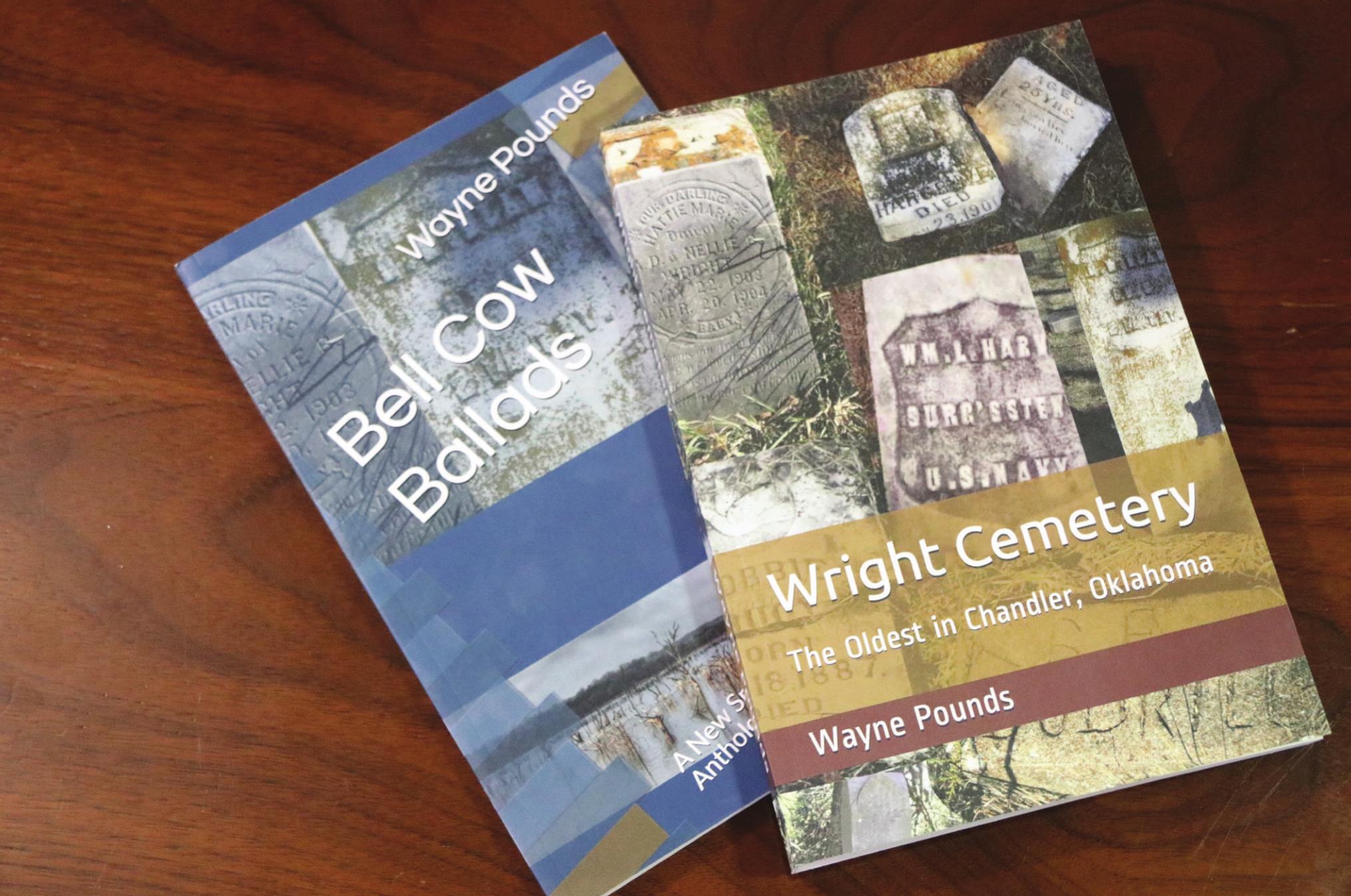
This approach to history is evident in Pounds’ recent project documenting the stories of those buried at Wright Cemetery in his book “Wright Cemetery: The Oldest in Chandler, Oklahoma” and its accompanying poem anthology, “Bell Cow Ballads.”
A former resident of Lincoln County and a retired university professor, Pounds now resides in Japan, where he moved for a university teaching job in 1978.
“My writing about Oklahoma comes in my retirement years,” he said. “When I was a university prof, I wrote academic papers.”
Despite the geographical distance, he enjoys writing about Lincoln County.
“I was born and reared in Lincoln County, and two sets of my great-grandparents homesteaded here,” he said. “Writing about home is closer to my heart than the topics of academe were. I truly enjoy writing about Oklahoma.”
Pounds said the distance has affected his writing.
“It has given me a new perspective, one which I hope enriches my old one,” he said.
The idea to write about Wright Cemetery stemmed from a project where he partnered with a group seeking to start Wright Cemetery Association.
According to his forward to “Wright Cemetery,” Pounds started helping the group with aspects of restoring the cemetery’s online records.
“In doing so I soon found myself caught up in the lives of the people buried here,” he wrote.
His book “Wright Cemetery” was the result.
In the book, he documents the lives of those buried in the cemetery.
“Though a few of the names were familiar to me, I did not have any personal knowledge of them,” Pounds said.
“I found myself writing a history of early Chandler. I enjoyed both the research and the writing—two parts of the same thing.”
The burials discussed in the book range from 1892 to 1912, and from unknown infant burials to some fairly popular figures of their day.
Despite the pre-Civil Rights Movement era, the cemetery was unsegregated, with no clear racial distinction made in the location of burial plots.
Pounds said he enjoyed researching part of this aspect of the cemetery.
“I think I enjoyed most the story of James Riley because there is genuine drama involved in his riding the Pullman car to Gettysburg because in 1938 trains were still segregated,” he said. “Mrs. Lena Sawner helped him to get on the train and take his place in the Pullman.”
According to Pounds’ book, Riley was a Black man who fought in the Battle of Gettysburg during the American Civil War and who received support from Lena Sawner in order to be permitted to ride the Pullman train to a Gettysburg veterans’ event.
“Hannibal Johnson’s fine book on ‘The Sawners of Chandler;’ was very helpful in teaching me about her,” Pounds said. “Johnson calls earlyday Chandler a racial paradise, and Mr. Riley’s story supports that notion, as whites and blacks had to work together to make that Gettysburg event happen.”
Other events during the lives of the cemetery’s occupants included the cyclone that hit Chandler in 1897, resulting in several burials at Wright Cemetery.
Pounds wrote “Bell Cow Ballads” as a companion poem anthology to “Wright Cemetery.”
Inspired by Edgar Lee Masters’ “Spoon River Anthology,” “Bell Cow Ballads” tells the stories of the people surrounding Wright Cemetery in narrative poem form. Each poem is written from the fictional perspectives of the people who Pounds researched for “Wright Cemetery.”
“I was a poet before I was a historian,” he said. “The poetry floated to the top of the biographies like cream in a bucket of raw milk.”
Both books are available for purchase on Amazon, and Pounds’ other research and writings can be found on Amazon, at uenowayne.blogspot.com, and on his Facebook page: wpounds46.