
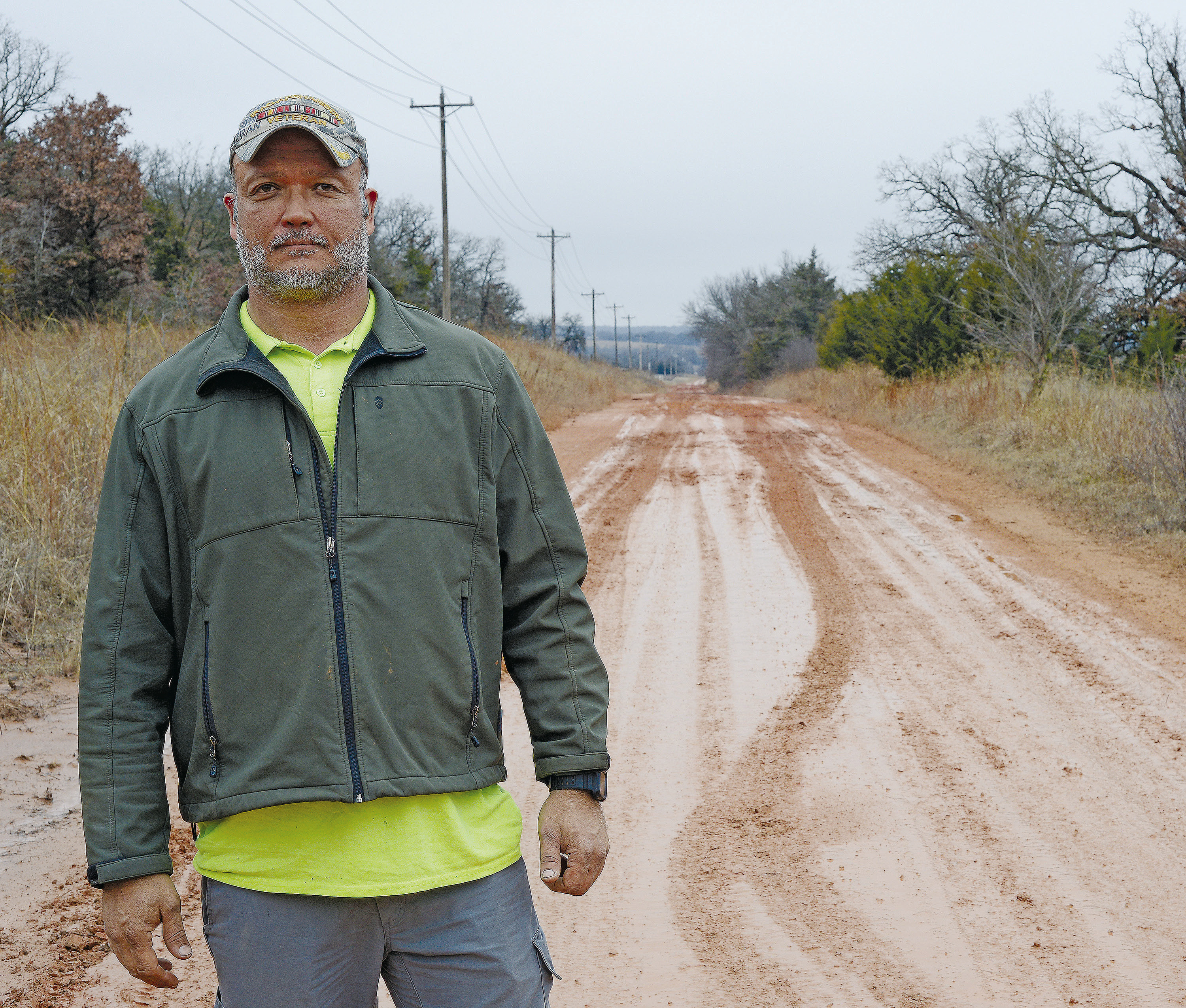
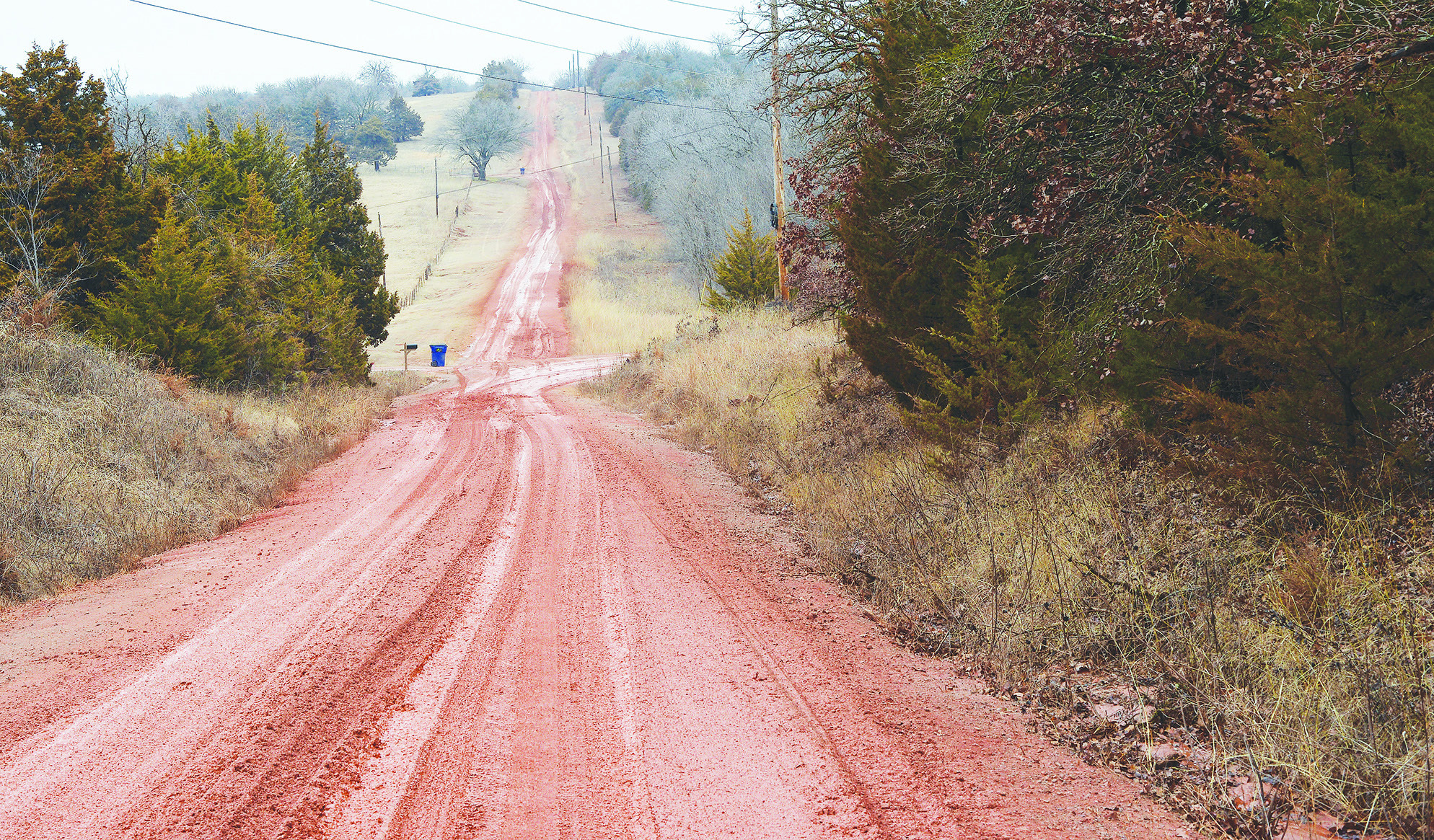
Last week’s ice storm across Central Oklahoma heavily damaged Lincoln County area roads and it will take some time to fix them.
It impacted travel for those who use the roads daily, among them school buses and businesses.
“They are indeed bad,” said District 3 Commissioner Lee Doolen said, “I thought some good roads which have never been a problem have just blown apart.”
District 1 Commissioner Will Fine and District 2 Commissioner Marlon Miller echoed Doolen’s assessment.
“Conditions are bad in the winter. When you mix ice and water with dirt you get a lot of mud,” Fine said.
Miller said “It’s just a combination of weather events. Once it thaws, it soaks it up like a sponge. Some roads are worse than others.”
“It happened right after the freeze, from the ice on Monday, that’s when they started falling apart,” Doolen said. “The moisture seeps into the road and the water expands and it starts breaking up what we refer to as the hard pan of the road.
“We had a half an inch of ice throughout most of Lincoln County.”
Travis Marak, who operates Marak Dairy Farm north of Meeker, emphasized icy conditions last week made it impossible for delivery of milk to his customers.
“It was a solid sheet of ice,” he commented.
“The cows can produce only the same amount of milk each day no matter whether it’s 60 days degrees or ice,” he said of his 36 Shorthorns he milks daily.
Marak said his stores were calling him inquiring where was the milk and he had to explain to them his concerns for his employees.
“Ice is a different story. I couldn’t get my truck out of the driveway. It’s very stressful on us,” he added.
“It came in on a Sunday night and we couldn’t get out to deliver,” he reiterated.
Doolen believes, too, that if he had to guess, “The arctic air allowed the ground to freeze deeper than normal. Everything froze harder. Meeker Lake still had two inches of ice on it Friday.”
Doolen said, “All of my asphalt roads are okay,” and Miller and Fine said that was true in their districts as well. He said a couple of those he expects to have a problem with in the future because of the life of them.”
Wellston School Supt. Mike Franz said of the past couple of weeks, “It’s been challenging. Last week we were out on Monday, then had to be out again on Tuesday because there was still some ice in spots and it was slick.
“It’s just not worth taking the risk,” he believes. “We’re good now,” he commented on Monday. “The roads are just sloppy and wet. We didn’t get any buses stuck, but a couple had to turn around and go a different route,” Franz stated.
He said the last two weeks they’ve had to take a couple of snow days each week.
Fine said this is the first year he’s had to deal with these.
“The bad areas I’m getting calls on I’m trying to gravel them as soon as I can,” he said. “We put gravel on them Thursday and Friday just where the gravel froze so deep and was causing more mud.
“I had a grader out to knock down the gravel where we put it down.”
Prague School Supt. Kevin Engle 2 said, “Last Friday, the roads were saturated, especially in the morning. We had a couple of buses get stuck,” he noted.
Engle said on Monday, “We got one out and Commissioner Fine had one of his graders pull out the other on Friday. We got them out pretty quickly.
“This morning (Monday) we’re good.”
Fine confirmed having one of his road graders pull out a Prague School bus that got stuck last Friday as it was turning around in a driveway and slid off into a ditch. “So we pulled it out,” he said.
He stated another bus reportedly got stuck on Friday, too, but school employees were able to maneuver the bus. Engle commented further, “We’d like to thank Commissioner Fine for the support of the school and all he does for us.”
The number of road miles in each of the commissioners’ districts is similar. Doolen and Miller pointed to having 525 while Fine has 532 road miles within his district.
Miller stated his crew has volunteered to work weekends and nights, “once it dries up.”
Agra School Supt. Jeff Kelly said on Monday, “No buses got stuck and that was a blessing. This is my sixth year and roads are always an adventure in this kind of weather.
“A lot of people don’t use the bus and that can be an issue for us,” he stressed.
Kelly pointed to his chief mechanic Ron Brown who is also a bus driver, noting he has good contact with the motor grader driver.
“We went virtual a couple of days due to the icy and hazardous roads. Our School Resource Officer Kevin Roe is a Lincoln County deputy and he drove the roads for us and gave us a report. Between the roads and cold temperatures we used some virtual days. We felt good about our decision,” he said.
Doolen pointed to one of the areas he referred to as “the worst of the worst” is north of Wellston on 3320 Road north of 860 Road. “That’s the area I inherited in the redistricting,” the commissioner further noted.
He said, “850 Road held up cause we had just rocked it.”
He and the other two commissioners mentioned they had driven most of their districts since the ice storm. “I’ve sampled roads throughout my district. But I can’t do anything until it dries it up.”
“Once it dries out, “We’ll hit it also,” Fine commented.
Miller said he normally drives 70 miles a day in his district, but since the ice storm has traveled around 100 miles daily surveying the roads and assessing the damage.
He mentioned, “It takes 50 loads of gravel per mile to fix them when we try to prepare a road. We can handle approximately nine a day. It takes six days to gravel one mile of road,” Miller added.
“Our budget allows about 2½ miles per month,” he stressed.
Doolen, pointing to the forecast this past weekend of rain on Friday into Saturday morning, was hoping it would dry out Sunday and Monday, possibly allowing his crew to begin work as early as last Monday afternoon.
Doolen predicted, “As it looks now, every road needs rock but once it dries out, maybe it won’t be that bad.”
Explaining the process of fixing them, Doolen said, “The very first thing we have to do is put the graders on them and fix them back to where we can assess what’s next.
“It cost around $20,000 a mile to rock a road. If I had to rock every road in my district it would be close to $20 million.”
Doolen further noted, “All the money I get in District 3 is about $3,500 to $4,000 per year per mile to maintain each road. My total annual operating budget is $2 million.”
Fine and Miller get the same amount, they confirmed.
Doolen, like the other two, emphasized “No property taxes fund county roads. Most people don’t know and don’t understand that,” he said, to which Miller and Fine concurred.
Miller, who reiterated what Doolen said about the three commissioners having identical budgets, stressed, “The majority of my budget goes to payroll, insurance, leases and diesel.”
He said, “In no way do we think the roads are satisfactory, but we just have to work with the budget the state provides.”
Miller added, “I want to thank everyone who has called in and thank them for their patience, and we’ll address the situation as quickly as we can.”