
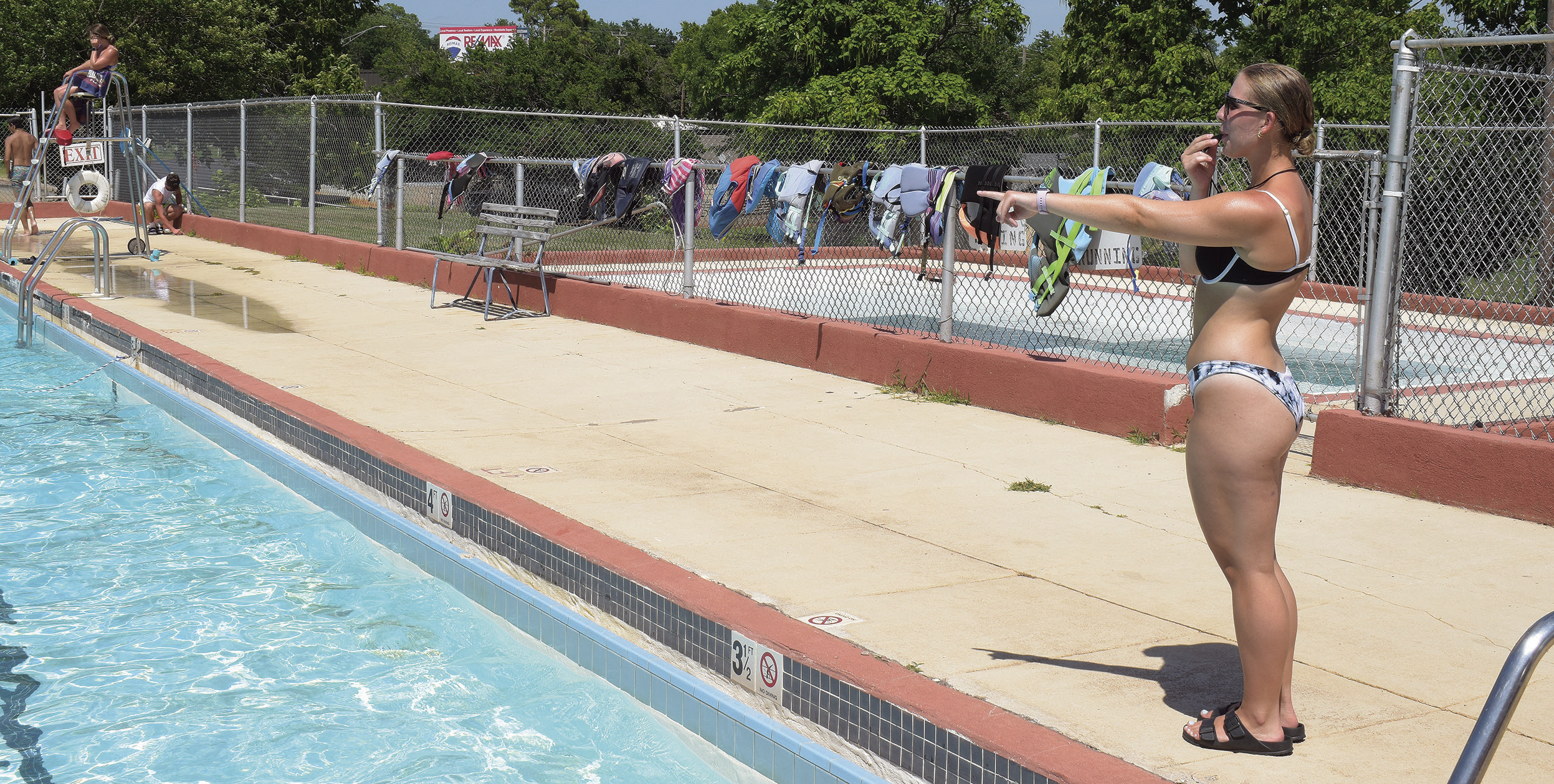
The happy shrieks and chatter of kids filled the air alongside the scent of chlorine and sunscreen.
Seated behind a desk, wrapped in a towel, Cynthia Snider seemed to carry on about four different conversations at once, never losing track of any. She would chat with fellow teacher pool staffer Hannah Smith, then turn to take money from new arrivals and chat with them, then turn to check her phone and let the lifeguard seated in front of the other side of the office how much time was left before the next break.
This would then be followed up with finishing the answer she had been asked before all of this began.
It was a bit chaotic, but everyone’s eyes would always drift out the window to the clear water of the pool, where about 50 kids were swimming and enjoying the summer afternoon that Friday.
Snider has been working at the Chandler pool for around 20 years. She took over running it when she returned to Chandler and began teaching at the high school, taking over from Judy Evans.
Up until a few years ago, she kept up with her lifeguard certifications.
“At 59, I decided not to be certified… I didn’t go back after my knee surgery because I didn’t want to crawl out of the side of the pool,” Snider said. She’d been certified since she was 15.
But she’s not the only one who keeps the pool running every summer season. Snider said she had a staff of about six lifeguards, including Smith. Smith mostly works in the office with Snider but fills in as a lifeguard when they are short-staffed. Most are high schoolers or in university.
However, being a lifeguard is more than just sitting around watching kids all day. They also have to help take care of the pool itself.
“At the end of the evenings, whatever lifeguards are here, they have to go and clean the bathrooms and toilets and hose everything down and spray everything with sanitizer with bleach,” Snider said.
Not to mention, it takes a fair bit to become a lifeguard in the first place.
“Getting the certification is the hardest part by far,” Smith said.
To be a lifeguard, one must go through the American Red Cross lifeguarding class and also take CPR and first aid for the professional rescuer, which comes to about 40 hours total between class and swim time. It can cost about $300, which is covered by the lifeguard.
“Some people don’t understand that there’s actually a class. They think that we just hire kids,” Snider said.
Lifeguards also teach private swim lessons in the mornings before the pool opens to the public. A typical day starts around 9 or 10 a.m., depending on how many lessons are booked. They tend to fill up quick, and currently, there aren’t any openings.
On Mondays, Wednesdays, Fridays, Saturdays, and Sunday, the pool is open from 1 to 6 p.m., while Tuesdays and Thursdays, they’re open until 5 p.m. The health department then holds water aerobics two nights a week from 5 to 6 p.m. which is followed by family swim from 6 to 8 p.m. On the average day, they have around 70 people coming during open swim.
Then most of the other nights, the pool is booked for private parties. They’re easily there until 8:30 p.m.
For both Smith and Snider, it’s teaching swimming lessons that is the most rewarding part of the job.
“Taking a kid and they won’t put their face in the water. Then working with them and by Friday, they’re jumping underwater, jumping off the side, swimming all the way across. That’s the most rewarding to watch them do that in just five days,” Snider said.
Smith added that she enjoys watching the kids come back each year.
“Last year, my son was like five to six, which is a good swim lesson range, and I thought like seven or eight of his friends. So this year, it’s fun to watch them come back, and they’re all fish in the water,” she said. “I like knowing that they’re all safe.”