


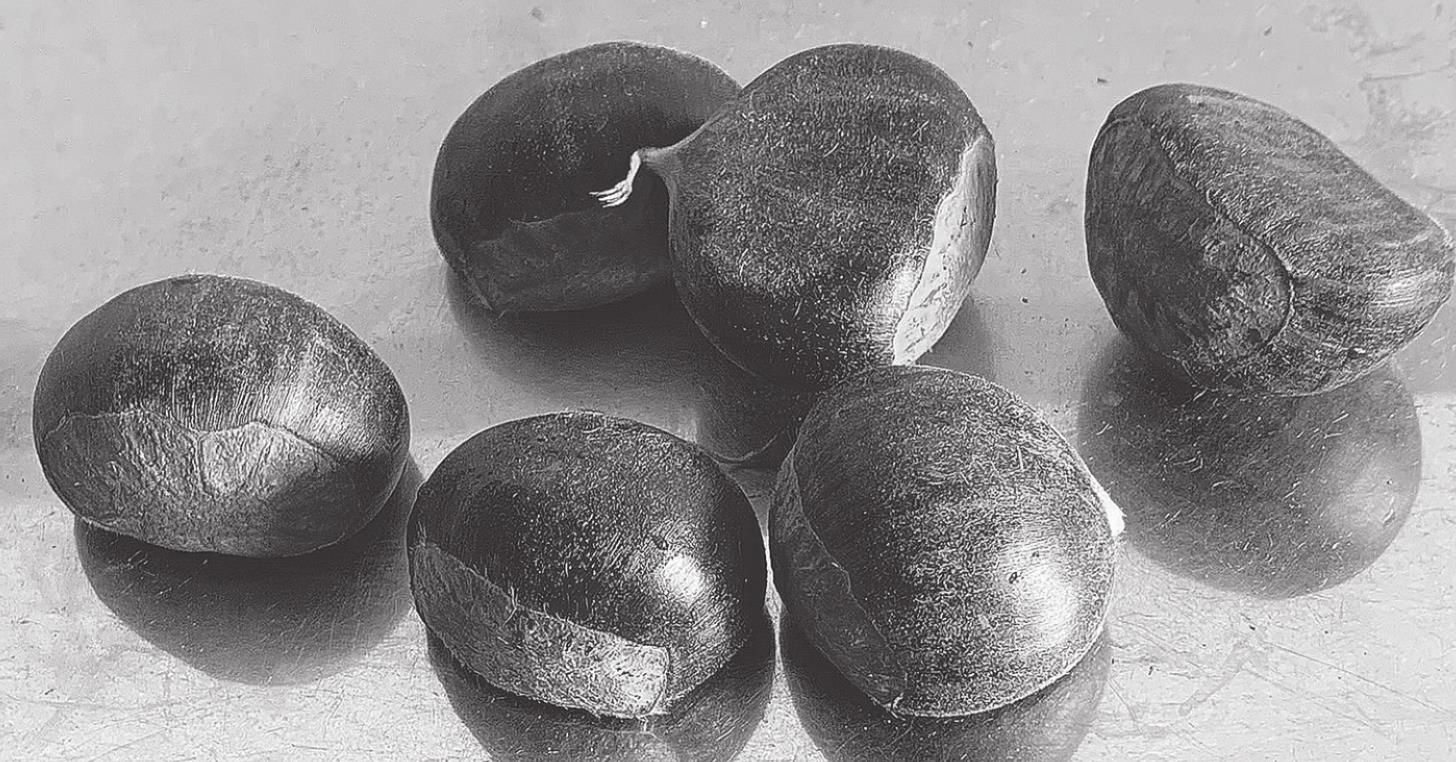
Talking about chestnuts makes Steve Lucas’ voice light up with enthusiasm. “I really appreciate the opportunity to try to educate people about chestnuts, and how it can be part of a diverse agricultural program,” Lucas said.
Growing chestnuts is an unusual agricultural field in Oklahoma, but it is one that Lucas started experimenting in about a decade ago.
He and his wife Jean’s chestnut farm, An Oklahoma Chestnut, has grown and expanded from the original main orchard in Chandler, Oklahoma, to an additional orchard in Tennessee and one in Alabama.
The idea for An Oklahoma Chestnut originally came out of a desire to shift their farm’s focus.
“We were trying to pivot from things involving animals and all the equipment for hay and so forth and looking for something that we thought might be a little less labor intensive,” Lucas said.
They started off trying a variety of trees in 2009, he said, but nothing seemed very marketable.
“We just kept looking. And one night we came across this article on the internet about chestnuts, and how there was an unmet demand for quality chestnuts,” he said. They visited other chestnut growers to learn more.
“We actually visited the four largest growers east of the Rocky Mountains,” he said. And they consistently, though they all had different types and sizes of operations, they just consistently said that as long as they were able to grow the crop and get a harvest they sell out every year.”
So, they decided to try growing chestnuts.
“What we thought would be just a small hobby, with chest nuts, grew from there,” Lucas said.
Perhaps most wellknown in the United States due to Christmas song lyrics, chestnuts are a variety of tree nut that is challenging to grow in Oklahoma’s soil.
After planting in Fall 2010 and 2011, only 63 of An Oklahoma Chestnut’s 1000 trees were still alive in August of 2012.
“We have clay, so the water sits on top of the ground, and it doesn’t permeate very far through the clay,” Lucas said “So what you end up doing is you end up rotting the chestnuts, or if you don’t rot them, then the squirrels, all the critters, will find them, dig them up and eat them.”
Because of these challenges, it’s important to give the plants a head start.
“With chestnuts you have to take the nut, or the seed, and put in the refrigerator for 90 to 120 days for it to germinate, stratify and germinate,” he said.
The trees are then put through a two-year, four step sequence.
“By the time you’re putting it in the orchard, it has a three-gallon root ball,” Lucas said. “So, it’s established, it’s well established, and it’s significant enough to make it through our very challenging environmental factors.”
To improve the trees’ chances of survival, Lucas researched the trees and learned about tree genetics.
“Just because something can grow effectively in northeast Kansas or Missouri or in the northeast U.S. or in Florida, they’re not going to necessarily have the right genetic makeup for the extreme weather changes that we have here,” he said.
So, he traveled to Northwest A & F University in Xi’an, China, to understand more.
“I learned a lot, saw different genetics that were effectively growing in similar — though not identical — somewhat similar types of soil and weather conditions,” Lucas said, “and came back and worked through the USDA to identify the genetics potentially of those different locations throughout China that had been brought to the US back in the ‘30s, ‘40s and ‘50s.”
Lucas had to work with trees that were already imported into the United States.
“It’s illegal to bring in chestnuts, and import them at this time,” he said. “and it’s been that way, probably for 50 years, so fortunately, before that, there were a lot of folks who brought in different genetic product.”
He also sought advice from Dr. Bruce Dunn, professor of horticulture at Oklahoma State University, on some of the challenges he was experiencing with propagation – the process of multiplying the plants.
“Dr. Bruce Dunn has been tremendous as far as supporting our efforts and our desire to study and research,” he said.
Dunn spoke equally highly of Lucas.
“He’s definitely dedicated towards it and wants to see that industry succeed so he’s not only focused on just himself but I think he’s willing to give back and he’s trying to get other growers involved,” Dunn said.
Today, after advice, experimentation and finding six genetic varieties that grow well in Oklahoma, An Oklahoma Chestnut now has approximately 3,000 trees across its three orchards.
“Once you find that right connection as far as the right genetics, then you can anticipate, you know, a harvest every year,” Lucas said.
Harvest typically runs from around the third week of Sept. to the second week of Oct., Lucas said, and during the harvest they need to be picked from the ground daily, to prevent animals such as squirrels from eating them.
An Oklahoma Chestnut sells trees to other growers from across the southeastern United States, as well as selling chestnuts directly to consumers and to Super Cao Nguyen, an ethnic grocery story in OKC.
Lucas said that his customers often have a deep cultural connection to chestnuts.
“When they can go to a location that has fresh chestnuts that are not all dried out and rotted, they can actually see the trees,” he said. “This may sound odd but many of the folks that come here for the first time, they almost are crying, you know, because of the emotional attachment to it.”
An Oklahoma Chestnut has received support and research help from numerous resources.
“We’ve had different people in the community that have been so supportive in so many different ways over the years,” Lucas said, “and we just are really, Jean and I are just really grateful.”