
Rock Cafe in Stroud
With concerns over COVID-19 still looming, travel this summer may prove difficult. But that doesn’t mean that individuals can’t explore the attractions in their own backyard, that they may never have visited before.
Route 66, known alternately as the “Mother Road” and “America’s Highway,” was formed in the 1920s as the first highway connecting Chicago and Los Angeles. Cutting straight across Lincoln County, the highway shaped a significant part of the region’s history, and its attractions offer an important glimpse into the past, as well as a welcome chance for fun without traveling far from home.
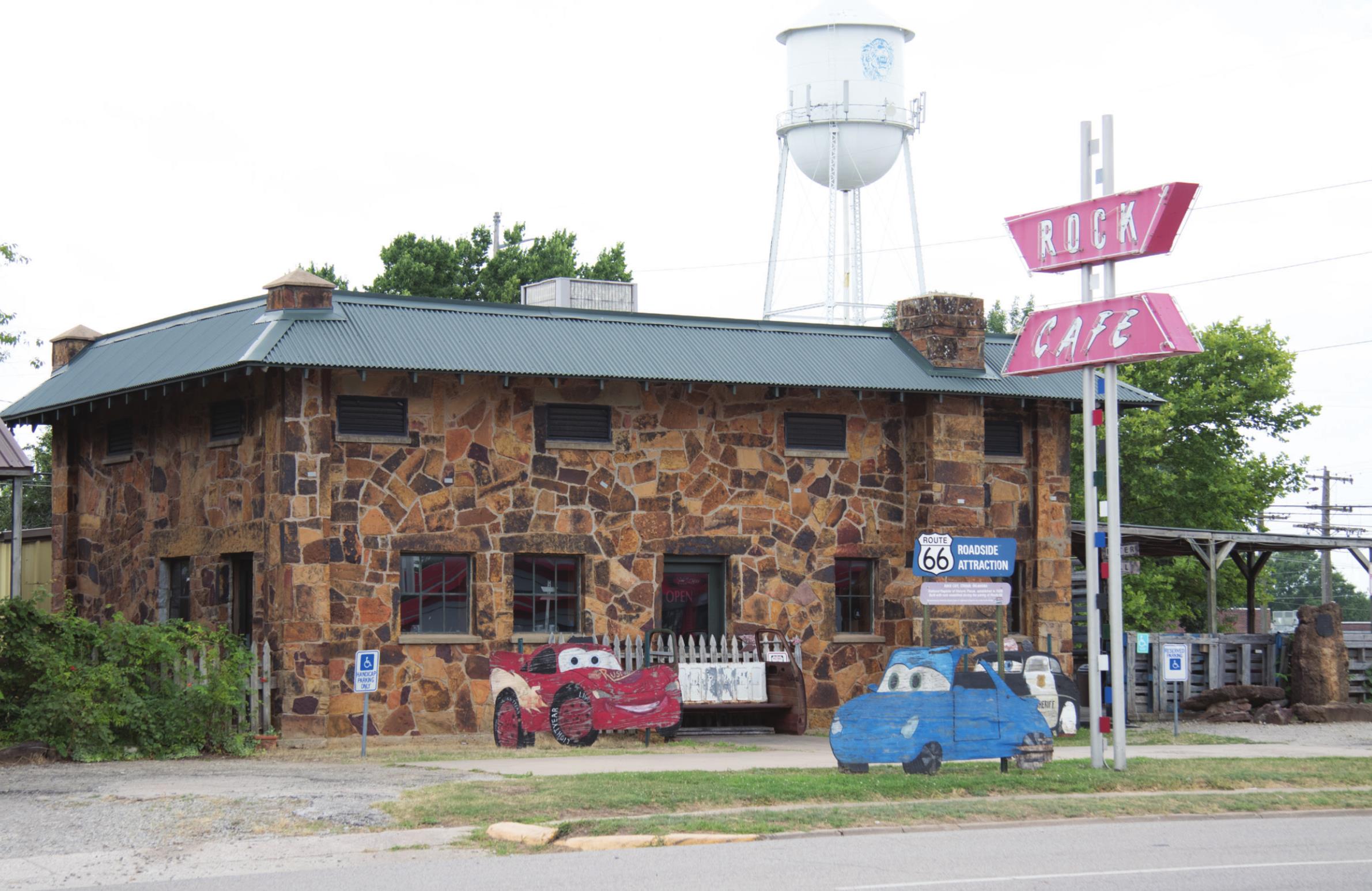
A torrential downpour lashed the variegated stones protecting the auburn wood paneled dining space of Stroud’s historic Rock Cafe.
“You know we say food, fun and history here,” Rock Cafe owner Dawn Welch said, “but really we’re trying to help people in any kind of way, you know, whether it’s feeding them or feeding their soul.”
The Rock Cafe was built in 1939 along Route 66, and still has its original grill – Betsy – and stone walls.
Today, the restaurant is known for its homestyle cooking, historic building, famous visitors and its link to the Pixar/ Disney franchise “Cars.”
The original stone exterior was built by WWI veteran Roy Rives, who had helped rebuild European taverns after the war and took those skills back to Okla. where he built the Rock Cafe with only the help of teenagers to lift the higher stones.
“They paid 5 dollars for all the rock in the building, from the Kellyville area,” Welch said.
The space went through various owners and operators, remaining mostly open and operational, except for a ten-year period where it was only open off and on.
Then Welch rented the café after she returned from traveling. She had flown to Miami, right after graduating from high school in Yukon, Okla., where she found work as a purser for Royal Caribbean cruise lines. When she came back to Okla., her mother had moved to Lincoln County.
She still remembers walking into the café for the first time, Welch said, intending to buy the equipment and start a restaurant in Costa Rica. Ultimately, she stayed in Stroud.
“Realized I was on Route 66 and it literally felt like I was on the cruise line industry again in the tourism business,” she said. “So, I used to call the Rock Cafe my cruise ship and Route 66 my ocean.”
She was 24, when she bought the café in 1993. Over the next several decades she ran the business while raising two children, each of whom she said were born at 11:06 p.m. shortly after she finished a full shift at the restaurant.
“I was able to live this really, really big, big, big life in a very, very small town,” Welch said. “I could watch my daughter go get quarters for me at the bank and the banker would come out and wave at me that she was there. So, it was like the best of both worlds.”
Then, late in the night, on the last Friday of the school year, 2008, the Rock Cafe burned.
“We closed at three. [Welch] went one way and I went the other,” Rock Cafe manager Beverly Thomas said. “We had a door check by the local PD at nine o clock at night – no smoke, no nothing. And at 10:30, I believe, or 11, she called me and said, ‘The restaurant’s on fire. Can you get up there?’”
By the time Thomas arrived, the café’s ceiling was gone. She said that the fire is believed to have started accidentally on the roof due to a mouse or other small animal.
“It burned off and on for three days,” Thomas said. “So, we were devastated. We sat in the gazebo until 4 a.m. Cried. And were mad.”
Welch said employees and town residents came out to watch as it burned.
“I thought that night, that would be it,” Thomas said. “There would be no more Rock Cafe. And Dawn [Welch] told me that night, ‘I know you’re going to have to get a job – don’t get a good job, get a job where you’ll come back to me’.”
The publicity the “Cars” films had given the café helped save the business, since it had raised the restaurant’s income and sales by approximately 50 percent.
“The movie came out in 2006,” Welch said, “and without the movie […] there’s no way we could have foreseen rebuilding the Rock Cafe because economically just the money would not have been there.”
The repair process was complicated by concerns over maintaining the building’s status on the National Historic Register.
In the end, the café was able to keep its original stone exterior and Betsy, the historic grill, during the post-fire restorations. One year and nine days after
One year and nine days after the fire, the café reopened.
“I think working here, it’s like working with a bunch of family members,” Thomas said, “and you get to listen to everybody’s stories. And I feel like being in a historical place that we’re keepers of history, and we tell stories.”
She said she’s spoken to customers who are in their 80s who’ve been coming there to eat since their very first date.
The type of food served hasn’t changed much, Thomas said, although a few international items – such as the German pasta dish spaetzle – have been added.
The café closed during part of Spring 2020 due to COVID-19 related concerns.
“When we closed our doors, we were paying 2.29 a pound for hamburger meat,” Thomas said.
“At its highest point we were seeing it at 8 dollars. You can’t run a business like that you just can’t. So, it was best for us to sit. Wait a minute, and see what’s going to happen.”
The café has since reopened but the effects of COVID-19 closures are still being felt there.
“Dealing with the fluctuation of the meat prices, not having any European tourism – Route 66 is very heavily a European tourist destination,” Thomas said.
She said it’s been difficult dealing with the uncertainty and that the café is not requiring masks or social distancing protocols.
“If you leave your house you’re in a COVID hotbed. That’s just all there is to it. We try to be safe – we try to be,” Thomas said. “We use bleach and we use sanitizer and we clean everything.”
Rock Cafe is open 7 days a week, 7 a.m.-9 p.m.