
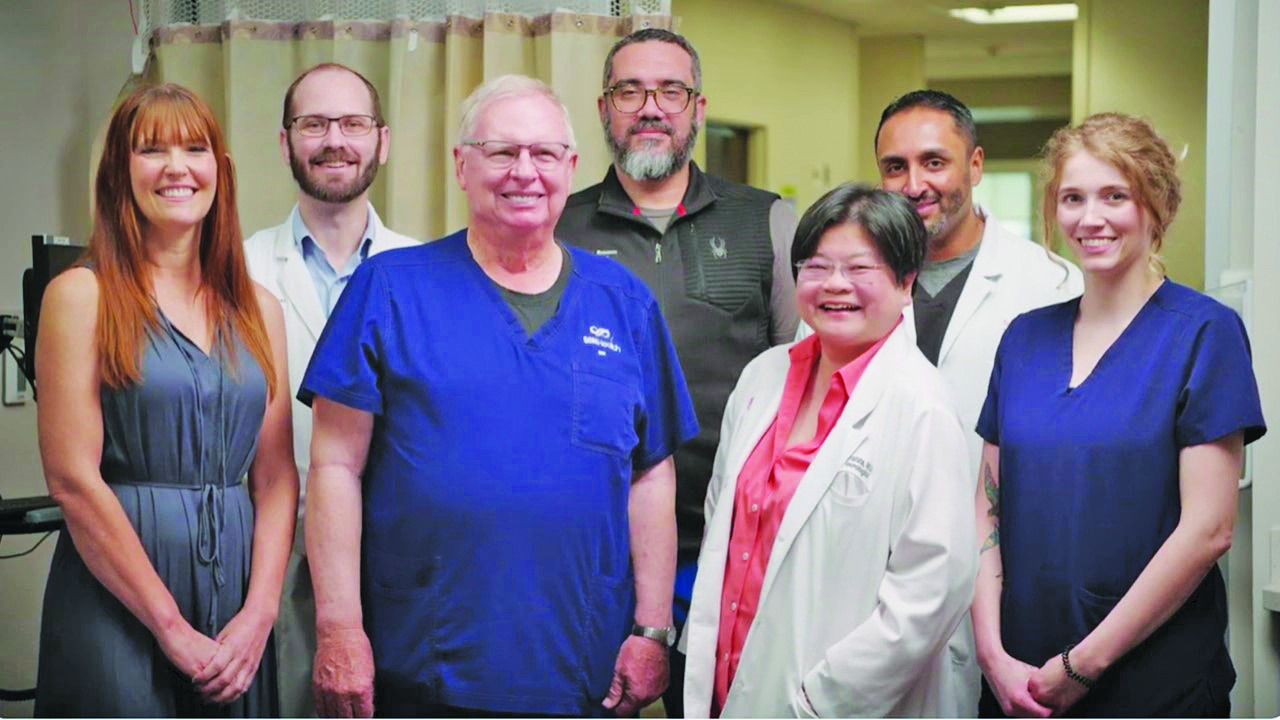
When Orville Fisher was first approached about working in the stroke program at SSM Health St. Anthony Hospital in 2014, he said it had been neglected and overlooked.
He had been working in the ER department for years as a nurse, but a run-in with a psych patient had left him with a back injury so bad that his surgeon wouldn’t clear him for bedside. It was then that he was asked for his thoughts about the stroke program.
“I said, ‘It’s terrible. Nobody knows what to do with it. Nobody knows what’s going on. They come up and ask you six months later about a patient, and you have no idea who they’re talking about.’ I said, ‘It’s just a mess,’” he said. “They said, ‘Well, good. You’re going to fix it.’” And fix it, he did. Fisher became the hospital’s stroke navigator. With his guidance, St. Anthony’s was able to drop its door-to-needle time from around 90 minutes to under 60 minutes. This is the time between when a stroke patient enters the hospital and when they are issued medication to help break the clot.
Three years ago, the hospital finally got its comprehensive certification, which means St. Anthony’s has the capability of doing mechanical clot extraction, Fisher explained.
“It has revolutionized stroke care. You can only do it on the most massive strokes because the vessel has to be physically big enough that you can get in to do that,” he said. “We have patients that just have had incredible recoveries.”
Reinvigorating the program didn’t come without its issues. Fisher admitted that he expected a lot of pushback; however, it did work in his favor that he knew all of the ER staff. It was an advantage that he had over others who had been in his position.
There was a steep learning curve as Fisher didn’t know the stroke requirements at the time. So he researched and attended seminars, and finally had a plan. That was when he approached the ER doctors. Even though they were skeptical, Fisher told them that they had to try.
Part of Fisher’s changes was to allow anyone to call a Code Stroke instead of only doctors. He also did a lot of education with doctors and staff on the latest stroke treatments and protocols. Fisher may have also banked on doctors’ competitive nature to help improve times.
“We stumbled onto the idea, I started posting the five fastest door-to-needle times that month in what they call the Doc Box. ER doctors are incredibly… oh, they’re almost like athletes,” he said with a chuckle.
After all that work on the program, Fisher then got to experience it from a perspective he never hoped to -- as a stroke patient himself. In 2021, he had his first stroke. On the way to the hospital, he had been able to call in and report it, so that he received medication before he even had a bed. He lost all vision on his right side, and without treatment, Fisher would have never been able to drive or be a nurse again. Thankfully, he was able to recover.
Fisher hasn’t lost his passion for stroke care, even though he’s technically supposed to be retired. He still goes in to help with the program from time to time.
He said the biggest drawback is that so many people don’t realize or accept that they’re having a stroke, and wait too long before they finally make it into the hospital. This can have drastic effects on recovery.
“You only have four and a half hours from the moment the symptoms start to where you get that drug. Now, if it’s a huge stroke, you have up to 24 hours on the mechanical,” he explained.
Fisher said that not all strokes have the “classic” symptoms, such as a droopy face or an arm that isn’t working.
Other signs that people may not recognize are having difficulty finding the right words (beyond normal, occasional lapses), vision loss, and dizziness similar to vertigo.
Also, strokes are no longer grandma’s disease. Fisher said demographics have been shifting, with the 45 to 65 and 65 to 85 age groups being almost even in terms of annual stroke rates, and often switching on which group has the most. Strokes are even happening in young people, kids, and babies.
Whatever the signs or a person’s age, the most important thing is to get it checked out, and quickly.
“Don’t wait. Go to the hospital. We’ll tell you 99 out of 100 times that nope, you’re not having a stroke. Thank God. Go home,” Fisher urged. “Other than the one time we tell you, if you would have been here an hour ago, we could have helped you.”
He said St. Anthony’s has an excellent treatment rate of 20 percent, which means that almost 80 percent of stroke patients didn’t arrive at the hospital in time to get treatment.
“You’ve got to get there.”